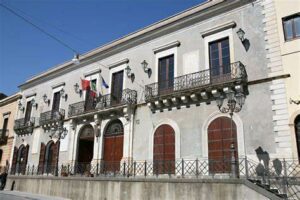

Il Palazzo Comunale di Valguarnera, un imponente edificio ricco di storia, originariamente fu costruito dalla famiglia Costanzo. Nel 1862, l’edificio fu venduto a D. Antonino Prato, che successivamente lo cedette al municipio di Valguarnera. Da quel momento, il palazzo divenne sede dell’amministrazione comunale, assumendo la sua attuale funzione di “Palazzo di Città”.
La storia del municipio di Valguarnera risale al 1812, quando la sede comunale si trovava in un modesto edificio composto da due stanze, situato tra la Matrice e l’antica piazza Vittorio Emanuele (oggi piazza Francesco Lanza). Questo piccolo spazio, pur nella sua semplicità, rappresentava il cuore amministrativo del paese. Fu solo più tardi, con la vendita del palazzo da parte di D. Antonino Prato, che la sede del comune si trasferì nell’attuale struttura, ampliata nel 1961 per adattarsi alle crescenti esigenze amministrative.
Al piano terra del Palazzo Comunale, trovano sede le due società più antiche di Valguarnera: la Società dei Nobili del 1862 e la Società Rurale Cristiana, fondata nel 1905. Queste realtà, che hanno contribuito alla vita sociale e culturale del paese, sono testimoni di tradizioni secolari e di un forte legame con la comunità locale.
Il Palazzo Comunale non è solo il centro della vita amministrativa, ma anche un simbolo del passato e della crescita del paese, unendo la storia locale con la modernità.

The Town Hall of Valguarnera, an imposing building rich in history, was originally constructed by the Costanzo family. In 1862, the building was sold to D. Antonino Prato, who later transferred it to the municipality of Valguarnera. From that moment, the palace became the seat of the town’s administration, taking on its current role as the “City Hall.”
The history of the municipality of Valguarnera dates back to 1812, when the town hall was located in a modest two-room building, situated between the Matrice and the old Piazza Vittorio Emanuele (now Piazza Francesco Lanza). This small space, though simple, represented the administrative heart of the town. It was only later, with the sale of the palace by D. Antonino Prato, that the municipal seat moved to the current structure, which was expanded in 1961 to meet growing administrative needs.
On the ground floor of the Town Hall are the two oldest societies of Valguarnera: the Società dei Nobili (Society of Nobles), founded in 1862, and the Società Rurale Cristiana (Christian Rural Society), established in 1905. These institutions, which have contributed to the social and cultural life of the town, are witnesses to centuries-old traditions and a strong bond with the local community.
The Town Hall is not only the center of administrative life but also a symbol of the town’s past and growth, uniting local history with modernity.